
Construction
Where Construction Debris Actually Goes Around Beaumont
The city excludes building debris from collection and closes its landfill to contractors. Here is where the material actually goes instead.
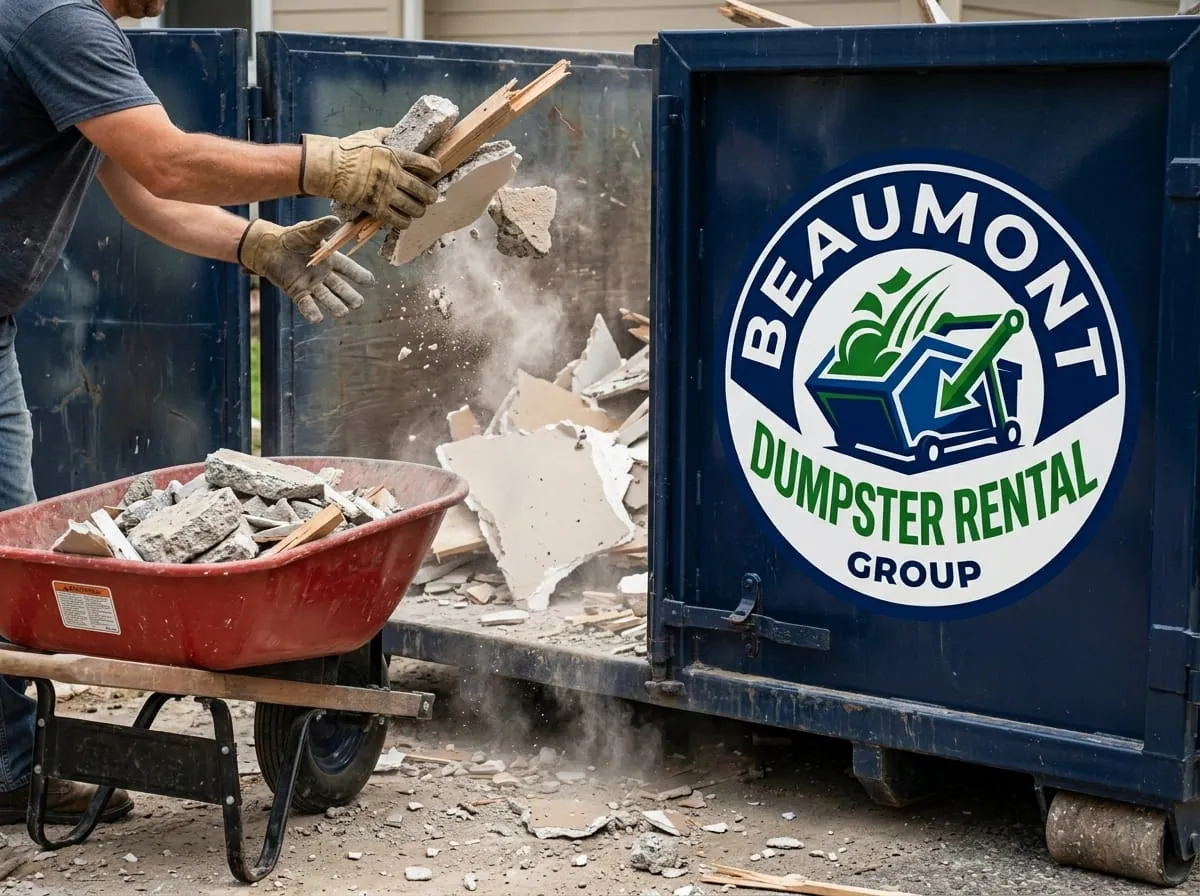
Two doors closed at once
Construction debris in Beaumont runs into two separate restrictions, and together they explain why roll-off containers do the work here.
First, the city will not collect it. Building debris — lumber, shingles, siding, insulation, brick, dirt, plaster, sand, gravel, large automobile parts, scrap metal and wire — is explicitly excluded from regular collection. Heavy trash takes furniture and appliances, not your bathroom gut.
Second, the municipal landfill is residential use only. So a contractor cannot simply drive the load out to Lafin Road, and even a homeowner's free-disposal privilege does not transfer to whoever is doing the work for them.
Why the city landfill is not the answer
Worth being precise, because people plan around it and then discover otherwise.
- 5895 Lafin Road, (409) 842-5686
- Monday to Friday 7:00am to 4:00pm
- Saturday 7:00am to 1:00pm
- Residential use only
- Closed on US federal holidays; all other holidays are regular working days for both collections and the landfill
For a homeowner with a trailer and a couple of trips, that is a genuinely good free option. For a job site producing debris daily over three weeks, it is not a route at all.
Vegetation cannot be buried
A local rule with real consequences for land clearing.
Yard waste is prohibited from being buried at the landfill. It has to be deposited in the compost area as directed by landfill personnel, and it is unlawful to put anything other than yard waste in that area.
On top of that, the city's own free yard-waste collection carries conditions that rule out most construction work outright. The property must be in a residential zone, not larger than one-half acre, the material must come from normal vegetation maintenance, the property must not be being cleared for construction purposes, and the trimmings must not have resulted from selling usable timber.
Read that again if you are clearing a lot to build on: the city service explicitly does not cover you. That is a container job from the first day.
Why stream separation saves money
Disposal is priced per ton and the rate varies by stream. Mixed C&D is the most expensive. Clean inert material is cheaper. Clean vegetation has its own route — here, a legally required one. Scrap metal has positive value.
Consider a lot clearance producing eight tons of brush and eight tons of mixed building debris. All in one container and you pay the mixed rate on sixteen tons. Split it and half of that moves to a cheaper route. Even after paying for a second movement, the split usually wins comfortably.
The five streams worth separating
1. Clean concrete, block and masonry
Rebar is generally fine. Timber, plastic sheeting, soil and general debris are not. Goes in a 10 yard because of weight, always.
2. Clean vegetation
Brush, limbs and clean woody material. Keep it genuinely clean and it takes the compost route rather than the landfill one. Soil is what usually ruins a vegetation load, so shake root balls out.
3. Scrap metal
Copper pipe, steel studs, ductwork, conduit, rebar offcuts and appliances. Out in the county, barn sheeting and old implements.
4. Clean dimensional lumber
Untreated, unpainted, fasteners removed where practical. Treated timber does not qualify, which matters here because fence and deck timber nearly always is.
5. Cardboard and packaging
New construction generates an extraordinary amount.
Storm rebuild work is different
This region has been through Rita, Ike, Harvey, Imelda, Laura and Delta inside twenty years, and the repair work never entirely stops. It has its own debris profile and its own sizing rule.
Saturated drywall, insulation, flooring and cabinetry weigh a multiple of their dry equivalent, so a container reaches its weight allowance well before it looks full. On elevation projects — common in Bridge City and Bevil Oaks — the programme runs in phases, with a full ground-floor strip-out followed by structural work, and the container plan should follow the phases rather than being booked once at the start.
Tell us it is storm work and we will size for weight and schedule around the sequence.
Asbestos and pre-1980 buildings
Beaumont has a substantial stock of pre-1980 housing, and older commercial fabric downtown and in Port Arthur and Orange. Floor tile and its mastic, pipe lagging and textured coatings are the usual culprits.
Anything from before roughly 1980 should be treated as asbestos-suspect until surveyed. Abatement is licensed work with its own disposal route and it never goes in a roll-off container. Get the survey done before demolition starts rather than halfway through a strip-out.
Practical site setup
- Place containers where the work is, not where they are convenient for the truck. Labour spent walking debris across a site is the largest hidden cost in waste handling.
- Label them. A sheet of plywood marked BRUSH ONLY protects the cheaper route.
- Brief the trades. One subcontractor throwing a lunch bag into the clean brush container costs more than the briefing would have.
- Keep clear of overhead lines. The truck bed needs roughly twenty-two feet of vertical clearance to tip.
- Book swaps into the programme, not on the day you notice the can is full.
- Watch the ground. Southeast Texas clay holds water and a site route that carried a loaded truck in August will not necessarily carry one in May.
- Cover heavy loads if rain is coming. You pay for that water by the ton.
We are happy to help set that up — tell us the build programme and we will schedule around the trade sequence.
Need a container in Beaumont?
Call and describe the job. Three minutes on the phone gets you a size recommendation, a flat rate and a delivery window — and we will tell you if a smaller, cheaper container is the right answer.
Call (409) 242-2706